
Future mapping
The purpose of Future Map is to highlight strategic opportunities and emerging needs and thus programmatic priorities.
You and your team will develop a shared map of key trends in the recent past, present, and three years ahead. You will review the map, identify patterns, and discuss the importance and urgency of different trends and how this may impact your organisation and work. This can strengthen planning and enable proactive and timely action.
This exercise is good to do in the beginning of a new strategy period or new programme but can be done at any point as part of a planning- or a strategy revision process.
This exercise can be done as a ‘quick and dirty’ exercise to bring about a quick overview and start discussions or as a more in-depth analysis, depending of how much time you can allocate for the exercise.
Preparations
Face-to-face: As preparation for the workshop make sure that you have a long empty wall with the area in front of it cleared. Divide the wall roughly into five equal sections with tape. If a wall is not available, put up five big flipcharts. At the top of each section (or flipchart) write with a thick marker: the last year, this year, and next year to three years in the future: e.g., 2021, 2022, 2023, 2024, 2025.
You now have a blank timeline to fill-in.
Online: Before the workshop, encourage participants to familiarising themselves with the chosen online platform (e.g., a short video tutorial). Prepare a digital whiteboard (in e.g. Miro) and create 5 boards or sections. At the top of each section (or flipchart) write: the last year, this year, and next year to three years in the future: e.g., 2021, 2022, 2023, 2024, 2025.
You now have a blank timeline to fill-in.
Facilitator tips
Make sure you have a varied representation of relevant perspectives, while at the same time considering power balances. E.g., perspectives of communities at risk, local thought leaders, decision makers etc.
As this is a fast, often loud workshop, soft spoken or introverted participants may slip into the background, especially when the group is large. Be sure to encourage full participation by lifting the softer voices and encouraging those who have not participated.
Get the team ready
Face-to-face: Give each participant a marker and a bunch of post-its.
Bring the group to stand in a horseshoe facing the wall. Explain the purpose of the workshop by giving them the below instructions.
Online: Make a good bunch of post-its ready for participants to use. Allow a bit of time for participants to familiarising themselves with the basic navigation and ask if anyone needs help. If not too many in the workshop and the context allows, encourage participants to turn on camera and unmute themselves for a more live workshop.
Explain the purpose of the workshop by giving them the below instructions.
Instructions:
- We will, as a group, co-create a vision of the future through the lens of the past and the present.
- Individually and silently, you will write significant trends on post-its: one per post-it.
- Trends can be negative or positive. Make an effort to consider both. Common for them are that they have the potential to significantly influence current work and our organisation.
Examples could be: Negative trends could be systemic shocks such as epidemics, economic collapse, natural disasters, climate changes, political collapse. Positive trends could be new enabling policies, new stakeholders in the humanitarian space, useful technologies, behavioural shifts, changing or new partnership opportunities etc.
Facilitator tips
The focus of the exercise can be narrowed to focus on a specific context, sector or thematic, for instance, only looking at technology trends, trends in the health sector, or general trends in the humanitarian sector in the country or region context.
Support the group to keep the pace up and encourage everyone to participate. If you feel the speed is dragging, ask relevant questions or make suggestions to inspire the group, e.g., what are your assessments and evaluations telling you? What are partners telling you? What do you see in local/regional media? What is academia or think tanks telling you? What will the past and present tell you about the future. You can also throw in your own suggestions to spark the group's thinking.
Identification of trends
Now the group is ready to write trends. Give them following instructions:
- You will individually identify trends on sticky notes and stick them on the board or wall
- Start with last year (e.g.,2021) and fill the space with sticky notes, then move to this year, then each subsequent year, until you have covered 5 years. Spend 5 mins per year. The facilitator will let you know when it is time to move on.
- Consider evaluations, assessments, network- and partner meetings and events etc. when identifying trends from last- and this year. Consider information from partners, government, new stakeholders in context, regional and global stakeholders, media, academia, think tanks, thought leaders etc. when considering trends for the coming years.
- There’s no need to wait your turn. As soon as you have one, write it down and stick it up.
- If you’re in a small group, read your sticky notes out loud as you go so the rest of the group can hear. If in a bigger group, do a collective catch up when individual contributions are up.
- Don't overthink it too much. The aim is to get lots of different driving drivers of change up on the wall. You will get to discuss them later.
- We’re aiming to fill "the wall" with positive and negative drivers of change covering 5 years in the next 25 minutes.
Facilitator tips
Often, we are used to doing these kinds of brainstorming in plenum. But insist that this is done individually to overcome potential 'group think bias' (i.e. everyone says and agrees on the same) and that only a few people in the team dominates the discussion. Support the group to keep the pace up and encourage everyone to participate. If you feel the speed is dragging, ask relevant questions or make suggestions to inspire the group, e.g., what are your assessments and evaluations telling you? What are partners telling you? What do you see in local/regional media? What is academia or think tanks telling you? What will the past and present tell you about the future. You can also throw in your own suggestions to spark the group's thinking.
Identifying patterns
Now it is time to identify patterns and themes from the individual contributions. If you did not read the sticky notes out loud when placing them on the wall, take a round for people to tell what they put on the wall.
If you a big group, divide into subgroups, and give them 10-20 minutes to sort the trends under each year and prepare a summary of the key patterns.
Face-to-face: Gather the team in front of the 5-year wall or flipcharts with sticky notes. Ask them to look at the sticky notes on "the wall" and look for patterns and common themes in each year. When the subgroups are done identifying patterns and themes, come back into the big group and share the outcomes.
Online: If the group is big, use breakout rooms to identify the patterns and common themes. Sort the trends by year and to prepare the summary of key patterns and themes. If in breakout rooms, call groups back and have the groups share their analysis, when time is up.
Have a board divided into the respective years ready for participants to work on.
Reflection and discussion
Run a group reflection and discussion. Some good prompt questions could be:
- What patterns do we see looking at this timeline?
- Which trends are most important for us to be aware of and learning more about?
- What do we have to respond to now? What can wait for later?
- Which investments do we need to make to stay relevant and impactful on the basis of the trends and patterns identified? E.g., developing certain skills, hiring certain profiles, start to advocate for certain asks, partnerships that we must begin to cultivate, technology we must begin to implement, research we must do etc.
- What does this mean for your current respective strategies, plans, budgets?
- What does this mean for your operational setup and role in X context?
Make sure to have someone taking notes from the discussion.
Allow good time for the discussion, like 45-60 minutes.
Key next steps
Wrap up the session by summarising the key themes from the discussion.
To make this exercise really impactful:
- Ask the team to define clear and specific next key steps that should be taken based on the discussion.
- Have the team identify how these steps should be reflected in guiding documents such as strategies, frameworks, plans and budget.
- Assign who is responsible for taking which steps forward when.
- Lastly, plan how the inputs and analysis from this exercise will be shared with the entire team as well as other potentially relevant colleagues outside of the team.
Strategising with Future mapping in Nepal
Why did you choose to use this tool and what was the challenge you wanted to address?
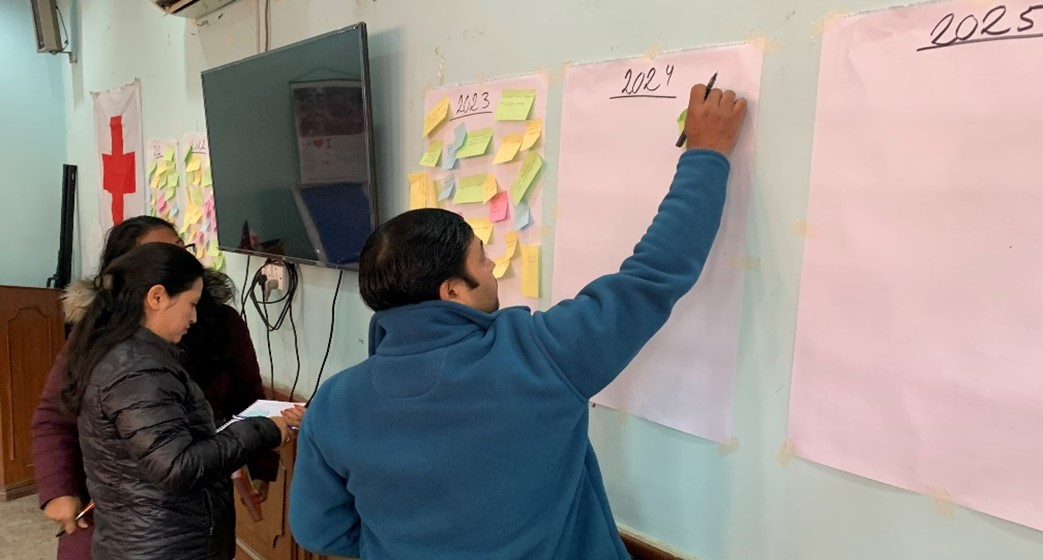
Future mapping was used as a brainstorming exercise over strategic opportunities and emerging needs to understand where attention might need to be in a given area and thereby ensuring being well positioned by building capacities and engaging in partnerships. This was part of a process to understand areas in which Nepal Red Cross Society and Partner National Societies could scale up or initiate engagement in youth and youth programming. After the timeline was populated during the brainstorming exercise, the participants summarised the many inputs in different groups and finally, in a joint effort, five overarching priorities were identified. The tool was chosen as it would be a good way to engage everyone and slowly tuning in on particular thematic areas.
What insights and learning did you get by using this tool?
The tool was really good in engaging everyone in a brainstorming exercise and afterwards in the smaller groups. More facilitation was needed in the last step with identifying priorities and ensuring they were both in line with strategies and possible. It was also a good visual to understand how many avenues to pursue under a given thematical area.
What advice would you give to other who are considering using this tool?
Visually, it worked well to have the entire timeline on one wall in a bigger room.
When using this tool, it was important to be familiar with the strategic priorities of the HNS for the discussions to be guided by existing plans and capacities with an eye on exploring new opportunities.
Sufficient time should also be countered in in the last part of the exercise when summarising the thematic areas into the priority ones. In this case, the discussion became really lively and there were a lot of opinions and points that were shared, and time should allow for this. Approximately 45 minutes has been allocated for the last discussion.